Is the future of story watching story unfold? Participating in story as it unfolds? The Washington Post’s Story Lab (which had a soft launch last week and official debut today) is about to find out. Marc Fisher, enterprise editor for local news, heads up a group of nine Post staffers assigned to the project (though [...]
Monthly Archives: November 2009
Marc Fisher on The Washington Post’s new Story Lab
I spoke this morning with Marc Fisher, enterprise editor for local news at The Washington Post. Fisher is heading up the organization’s new Story Lab, which launched this week. See our next post for the Storyboard take on the Lab.
Can you tell me a little about the genesis of the Story Lab?
We restructured our whole [...]
Killian Mansfield: a holiday lament
Before the Thanksgiving holiday, we step away from the future of story and transmedia discussions to offer a classic print narrative. David Amsden’s “Never Mind the Pity” traces the elegant arc of the last year of a boy’s life and the musical collaborations that transformed his final days.
The story, from the October issue of New York magazine, resists many of [...]
The end of the line for the Lone Ranger? A how-to guide for narrative collaboration
When The Roanoke Times “Age of Uncertainty” won Documentary Project of the Year from Pictures of the Year International, it wasn’t the narrative writing or the photography or the Web design they wanted our insights on. They asked us to speak at their 2009 conference about a topic more nuanced and, I would argue, more important [...]
Esquire’s Tom Junod looks for “One Good Man”
Esquire’s Tom Junod crawls under his subjects’ public masks and starts asking questions. Junod has long specialized in profiling symbols such as a man falling from the north tower of the World Trade Center on 9/11 and the modern would-be mercenary.
His latest profile, “Can One Good Man Redeem a Nation for the Sins of Guantánamo?,”begins [...]
Fallout: Brookhaven National Lab’s Legacy in the Pacific
While we love the classic storytelling of Gary Smith or Chris Jones, sometimes a Notable Narrative attracts our attention even if it sits on the border between narrative and straight news. “Fallout,” an August print and video package from Newsday, falls into the second category. (The video can be seen at the bottom of this [...]
Tyler Cowen rails against narrative—can stories make us stupid?
Earlier this month at the mid-Atlantic TEDx in Baltimore, blogging economist Tyler Cowen gave a 16-minute talk about the dangers of narrative. He spoke about the oft-discussed universal stories we use to make sense of events, such as the quest, a stranger comes to town, comedy, and tragedy.
But he quickly dove into why he distrusts the very [...]
Comic book news: survival tales (part 3)
[Part 1 of this series looked at the turn toward individuals telling true stories via comics, while Part 2 illustrated how comics began to use a subjective vantage point to record history.]
[caption id="attachment_1098" align="alignleft" width="239" caption="Le Photographe, Tome 3/Dupuis"]
[/caption]
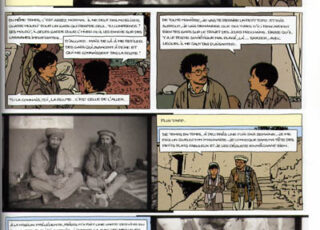
Emmanuel Guibert’s and Didier Lefèvre’s Le Photographe moves the field of nonfiction comics toward narrative journalism by revealing the documentary potential of graphic storytelling. Guibert recounts the journey of a photographer (Lefèvre) who records the work of a Medecins Sans Frontières mission in northeastern Afghanistan in 1986. Released in France between 2003 and 2006, the three volumes span 260 pages and follow Lefèvre from Pakistan to Afghanistan and back.
Though its achievements are similar to those of Joe Sacco’s Palestine and Safe Area Gorazde (discussed in Part 2 of this series), Le Photographe unfolds in radically different form. The series’ most striking aspect is the unusual combination of documentary photography (Lefèvre’s original work) and highly stylized drawings.
The Auburn Chautauqua: a do-it-yourself literary conference
Atlanta Magazine reporter Thomas Lake recently hosted an unusual narrative conference at his family’s homeplace in rural Ludowici, Georgia.
The Auburn Chautauqua—named for the educational movement that brought cultural and entertainment programs to rural America—drew a dozen or so reporters and editors from a half-dozen states to Auburn, a rambling old house filled with family photos [...]
Comic book news: Joe Sacco draws on history (part 2)
Part 2 of a look at graphic narrative journalism
[Part 1 discussed how “comics journalism” rose from the underground and independent comics scene to combine conventions of the traditional comic book with telling personal, true stories.]
The 1990s “indie” comics scene saw two trends. One reflected an almost neurotic drive to get away from the power fantasies of superhero stories. Using a careless graphic style that emphasized the pathologically normal, authors told stories from the point of view of a “defeatist,” in the words of comics artist Joe Sacco.
On the other hand, this was the era in which American non-superhero comics also started engaging with topics bigger than the middle-class suburbs of their creators. Inspiration came from the sudden acceptance of comics in the wake of Art Spiegelman’s 1992 Pulitzer Prize for Maus, which also built a bridge between the artistic language of the European bande dessinée and its comparatively low-brow American cousin.
Bringing these two trends together, the first issue of Joe Sacco’s Palestine came out in 1993, followed by nine original single comic book issues. Trained as a journalist, Sacco tells the story of the two months he spent in the West Bank and the Gaza Strip between 1991 and 1992.