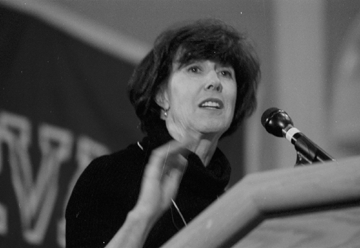
Before she wrote Silkwood, before she fictionalized her divorce from Carl Bernstein in the novel Heartburn, before she felt bad about her neck or put Sally with Harry or gifted the world with “I’ll have what she’s having,” Nora Ephron was a newspaper reporter. For five years, just out of Wellesley, she wrote for the New York Post. “A great NY dame,” the paper called her after she died on June 26, at 71, of leukemia.
After the Post of course came Ephron’s magazine period and groundbreaking, witty essays on feminism for Esquire and New York: about bake-offs (freedom), about vaginal spray (exploitation), about Dorothy Parker (reality) and about, perhaps most famously, breasts (femininity). By the time she took her clear eye to Hollywood (“smart mouth/soft heart,” as the L.A. Times put it), she had turned out a body of work that had supercharged the essay form by telling certain stripped-down truths. Here she is in “The Girls in the Office,” from 1972:
One of the themes the women return to frequently in The Girls in the Office is their belief that men are just little boys, infants with “hang-ups in their brains like spider webs.” I have heard this theme song so many times from so many women; and every time I hear it, I recoil. It is, quite obviously, a profoundly anti-male remark; it is also, I’m afraid, partly true. Saying it’s so gets us nowhere, though. The unhappy corollary to the fact that a lot of men are just little boys is the fact that so many women put up with it — cater to it, in fact, mother them, bolster their egos by subjugating their own — and feed right into the real problem, which is not that men are little boys but that men don’t like women very much, can’t deal with their demands, their sexuality, their equality.
Some of Ephron’s most memorable work can be found in her collections Crazy Salad: Some Things about Women (1975) and the follow-up, Crazy Salad Plus 9. And some of her best insights about writing can be found in an essay published in Telling True Stories, a guide that grew out of our former Nieman narrative writing conference, where Ephron once gave the keynote address. You can find the full essay, “What Narrative Writers Can Learn from Screenwriters,” in the book. In the meantime, here are some great lines:
On experience
By the time I became a screenwriter, I knew a few things, because I had worked as a journalist. When I wrote Silkwood, I knew what a union negotiation looked like because I had been in on several of them.
On stories
As a young journalist I thought that stories were simply what happened. As a screenwriter I realized that we create stories by imposing narrative on the events that happen around us.
On structure, part 1
Structure is the key to narrative. These are the crucial questions any storyteller must answer: Where does it begin? Where does the beginning start to end and the middle begin? Where does the middle start to end and the end begin?
On voice
I had been working as a journalist for nearly eight years before I could easily write in the voice that I turned out to have.
On structure, part 2
All the regular questions that face writers also faced us. Where does the story begin, where is the middle, and where is the end? Each of those things is entirely up to the writer. They are the hardest decisions for any writer to make about any story, whether fiction or nonfiction. If you make the right decision about structure, many other things become absolutely clear. On some level, the rest is easy.
On medium
Too few journalists become screenwriters. I say to all the would-be screenwriters: Become journalists. And I’ll say to working journalists: Do not stay journalists. Become screenwriters.
On structure, part 3
Because I started out as a journalist, I believe that if you just keep reporting, eventually you will come to know the structure that your story should have. A certain moment will come when you have figured out how to start, what to put in the middle and what can wait until the end.
Thanks, Nora, and goodbye.